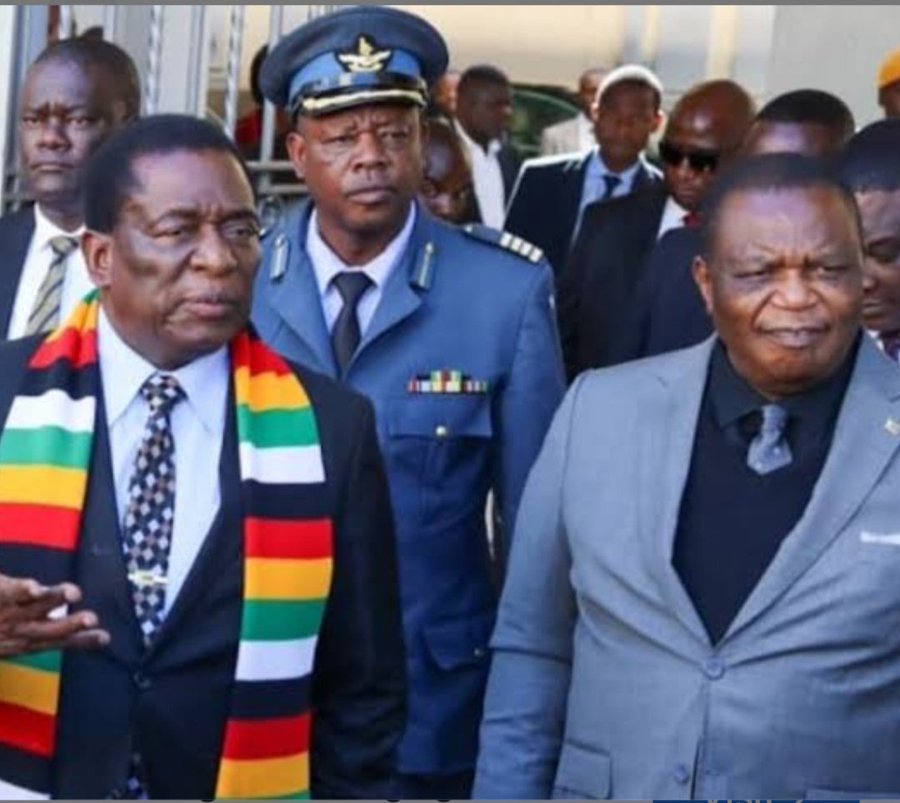
Zanu-PF Presidential Term limits Plot A Fraud.
The idea being advanced by Zanu PF officials, legal enablers and political consultants that Zimbabwe’s constitution fixes the number of presidential terms at two, five-year each, but leaves the length of each term flexible is not just a controversial interpretation of the law being used by some within the ruling party to justify extending President Emmerson Mnangagwa’s rule to 2030 without a public referendum, but a patently absurd proposition.
It has no basis in the current text of the constitution, its letter and spirit, and foundational principles of a constitutional democracy.
Presidential term limits were introduced to the Zimbabwean constitution in 2013 to prevent concentration of power, ensure peaceful transitions, and allow for regular multi-party elections every five years, a direct response to the protracted disastrous rule of the late former president Robert Mugabe who was toppled by President Emmerson Mnangagwa – for mainly that reason – in a coup in November 2017.
The constitution limits the president to two five-year terms, and this provision was designed to be difficult to change for an incumbent, although some within the ruling party are pushing for amendments to extend the current office-bearer’s tenure beyond his 2028 second term constitutional limit.
Presidential term limits are clearly defined in Sections 91 and 95 of the constitution, which limit the presidency to two five-year terms. An amendment to the term limits would require a referendum and would not apply retroactively, meaning an incumbent president cannot benefit from the change to extend their current term or run for a third term.
This non-retroactive clause was a point of discussion when Mugabe signed the 2013 constitution, as it allowed him to continue his term despite the new limit.
During the 2000 state-sponsored constitution-making process it became the deal-breaker.
It almost became one in 2013.
But now Zanu PF leaders, their legal enablers and political consultants are telling the nation that the constitution has term limits without a specified length of terms.
They claim there is a legal lacuna, a gap or loophole in the law, which is deeply flawed an argument when the background, the process and prevailing spirit of law, including the zeitgeist then, as well as the foundational principles of a constitutional democracy and the intention of constitution-makers are fully and frankly considered.
This argument was first publicly initiated by Professor Jonathan Moyo, although Zanu PF officials had been talking about it on the ground and in the background.
Zanu PF leaders are themselves divided over it.
Mnangagwa and his Zanu PF faction is conveniently supporting this.
However, Vice-President Constantino Chiwenga and his camp are opposed to it.
Yet there are some who objectively know the correct position like Zanu PF former legal affairs secretary Patrick Chinamasa, a lawyer, who told the ruling party annual conference in Bulawayo last year that for Mangagwa to extend his rule to 2030, he must first accept the party resolution, and then two subsequent referenda would have to be held to remove term limits and then allow the incumbent to benefit.
Publicly, Mnangagwa says he is a
constitutionalist – which is ironic for a leader who first came to power through a coup – and would thus not accept it, although he is secretly encouraging it.
Mnangagwa, a lawyer whether he practiced or not, knows that it is illegal what they are doing, hence his back door political manoeuvres to change the constitution to remove term limits like many authoritarian leaders have done across Africa.
This thing is common all over Africa.
There is no innovation which Zanu PF leaders are making. They are just following in the footsteps of dictators.
This sort of thing has triggered political unrest and instability, as well as social strife and coups across Africa.
It is despotic and totally undesirable.